Profile URL: https://hdl.handle.net/20.500.13091/11560
Job Title:Prof. Dr.
Email Address:meargun@ktun.edu.tr
Main Affiliation:02.06. Department of Environmental Engineering
Status: Current Staff
ORCID: 0000-0001-7203-1971
Scopus ID: 9843260900
YÖK Akademik: 18278294BBEC6115
Google Scholar: R4uIshEAAAAJ
Web of Science ID: V-7869-2017
Name Variants:
Argun, M. Emin Argun, M. E.
39 results
Scholarly Output Search Results
Now showing 1 - 10 of 39
Other Investigation of Life Cycle Assesment for Rural Wastewater Treatmant Plants(2023) Argun, Mehmet Emin; Ahmadi, Abdul Wahed; Doğan, SelimOther Atıksu Arıtma Tesislerinde Mikrokirleticilerinizlenmesi ve Kontrolü(2019) Kara, Meryem; Nas, Bilgehan; Argun, Mehmet Emin; Yel, Esra; Dinç, Saliha; Koyuncu, SerdarYerüstü ve yeraltı sularında su kalitesinin belirlenmesi için AB Su Çerçeve Direktifindeki 45 öncelikli maddede yer alan MK?lerin izlenmesi yönünde araştırmalar hızlanmıştır. Su kütlelerinde MK?lerin önemli kaynaklarından biri atıksu arıtma tesisleri (AAT)?dir. Bu projede, küçük, orta ve büyük ölçekli 3 yerleşim yerinde 3 farklı arıtma prosesinde MK?ler 1 yıl süreyle izlenmiş ve proseslerin MK?leri giderme performansları ortaya konulmuştur. MK gruplarından; pestisit (Kloropirifos, Atrazin, Klorfenvinfos), fitalat ester (BBP, DEHP, DnOP), yüzey aktif madde (Oktil fenol, Nonil fenol), PAH (Benzo[b]fluoranten, Benzo[k]fluoranten, Benzo(a)piren, Indeno[1,2,3-cd]piren, Benzo[g,h,i]perilen, Fluoranten, Antrasen, Naftalin), VOC (Diklorometan, Benzen, 1.2-dikloroetan), ilaç etken madde (Diklofenak, Karbamazepin, 17-beta-estradiyol, 17-alfa-etinilestradiol) ve ağır metallerden (Cd, Pb, Hg, Ni) toplam 27 MK izlenmiştir. Konya (İleri biyolojik arıtma), Ereğli (Anaerobik ve fakültatif stabilizasyon), Zincirlikuyu (Yapay sulak alan) AAT?lerinden, atıksu geri kazanım tesisinden, pilot ölçekli ultrafiltrasyon (UF), nanofiltrasyon (NF) ve ters osmoz (RO) ünitelerinden oluşan membran tesisten her numune alma döneminde 17 su, 6 çamur numunesi alınarak GC/MS, LC/MSMS ve ICP/MS?de MK ölçülmüştür. Tesislerin ve arıtma proseslerinin MK verileri arasındaki ilişkilerin anlamlılığının istatistiksel olarak ortaya konulabilmesi için saçılma diyagramları, kutu diyagramlar, varyans analizi ve Korelasyon hesaplamaları yapılmıştır. Atıksularda en yüksek konsantrasyonda tespit edilen MK?ler; sırası ile Ni, DEHP, Nonil fenol, Naftalin, Pb ve Diklofenak?dır. VOC?ler en düşük konsantrasyondadır ve görülme sıklığı çok düşüktür. Her üç AAT?de arıtılmış atıksuda; Ni, Pb, Hg, DEHP, Nonil fenol, Naftalin, Diklofenak, Karbamazepin hariç olmak üzere diğer MK?ler 100 ng/L?den düşüktür. %80?in üzerinde verimle arıtılan MK?ler Konya AAT?de Oktil fenol (%93,4), Nonil fenol (%92,7), Atrazin (%92,1), Naftalin (%91,5) ve DEHP (%89,3); Ereğli AAT?de Atrazin (%83,8)?dir. Zincirlikuyu AAT?de hiçbir parametrede %80?den fazla giderim gerçekleşmemiştir. Konya AAT?de Karbamazepin ve Ni, Zincirlikuyu AAT?de Nonil fenol negatif kütle dengesi görülen ve çıkış suyunda konsantrasyonları artan MK?lerdir. Membran proseslerden, UF?in MK gideriminde etkin olmadığı, NF?in 17 MK?de %50?den fazla giderim sağladığı görülmüştür. RO, NF?den sonra bazı MK?lerde ilave giderim sağlamıştır.Article Citation - WoS: 40Citation - Scopus: 46Evaluation of Occurrence, Fate and Removal of Priority Phthalate Esters (paes) in Wastewater and Sewage Sludge by Advanced Biological Treatment, Waste Stabilization Pond and Constructed Wetland(Pergamon-Elsevier Science Ltd, 2022-05-01) Nas, Bilgehan; Ateş, Havva; Dolu, Taylan; Yel, Esra; Argun, M. E.; Koyuncu, S.; Dinç, S.Phthalate Esters (PAEs), detected in high concentrations generally in treated wastewater discharged from wastewater treatment plants (WWTPs), are important pollutants that restrict the reuse of wastewater. Investigating the fate of these endocrine-disrupting chemicals in WWTPs is crucial in order to protect both receiving environments and ecosystems. For this purpose, di(2-ethylhexyl) phthalate (DEHP), di-n-octyl phthalate (DNOP) and benzyl butyl phthalate (BBP) in the group of PAEs were monitored in simultaneously both in wastewater and sludge lines of selected two nature-based WWTPs and one advanced biological WWTP. Although it was frequently stated that phthalates were significantly removed in WWTPs in many studies found in literature, negative removal efficiencies of selected phthalates in investigated WWTPs during the sampling period were observed generally in this study. One of the reasons for this concentration increase could be releasing of phthalates from microplastics in wastewater during the treatment process or the desorption of PAEs from treatment sludge. DNOP was the compound with the highest concentration increase at almost each treatment unit of the three WWTPs. On the other hand, total PAEs load was 1997 g d(-1) in advanced biological WWTP and adsorption onto sludge of PAEs were determined as 90%. The side-stream total load returned from the decanter supernatant was 0.02% of the total PAEs load coming to advanced biological WWTP from the sewer system. As a result of detailed statistical analysis, the correlation between raw wastewater and primary clarifier (PC) effluent was determined as an increasing linear relation for DEHP and DNOP. On the other hand, moderate and strong correlations were observed both between septic tank and constructed wetland (CW) processes with raw wastewater. In the waste stabilization pond (WSP), while a significant correlation was not found between the sludge line data, homogeneous variance, strong and moderate correlations were obtained in the wastewater line data. However, while mean differences for all investigated PAEs were not significant (p > 0.05) in the wastewater line, mean differences of DEHP (p < 0.05) were significant in the sludge line according to ANOVA analysis.Article Citation - WoS: 1Citation - Scopus: 1Management of Sour Cherry Processing Industry Wastewater by Super Critical Fluid Method: Sequential Recovery and Treatment(Elsevier, 2025-07-01) Argun, M. Emin; Ates, Havva; Argun, M. Samil; Cakmakci, OzgurThe fruit processing industry wastewater contains a significant amount of bioactive substances. In the sustain-ability framework and the circular economy, the by-product can be transformed into valuable resources before being treated. By integrating management strategies, the industry can minimize its environmental footprint, promote economic benefits, and support the sustainability of freshwater resources. This study subjected consecutively recovery (supercritical CO2: SC-CO2) and treatment (supercritical water oxidation: SCWO) by using the supercritical fluid method. In this study, sour cherry UF retentate with high-load organics, which include especially valuable phenolics was used. The mean COD and total phenolic substance content (TPC) were determined as 15,650 mg/L and 457 mg GAE/L, respectively. Recovery efficiencies of TPC and total flavonoid substance content (TFC) of extracts were up to 5 % and 10 % with SC-CO2 extraction, respectively. Additionally, the highest enrichment efficiencies were determined as 35 % and 140 %. While the TPC of sour cherry UF retentate was 72 mg/100 g sample, it increased up to 278 mg/100 g in the extract obtained under 40 degrees C and 30 MPa. Flavonoids from phenolic substances had high recoverability in SC-CO2 compared to the other phenolic groups. Following extraction, the samples were treated using the supercritical water oxidation process. Wastewater with high organic load was effectively treated in a short time (15 min) and the removal efficiencies changed between 78 % and 98 %. Additionally, toxicity tests were conducted in selected optimum extraction (27 MPa and 40 degrees C) and oxidation (1.68 DOD and 3 min) conditions, and the toxicity units of extracted and treated wastewaters decreased compared to those obtained from raw wastewater for Daphnia magna and Vibrio fischeri toxicity tests. These findings show that the supercritical fluid method can be a favorable alternative for management of fruit juice industry wastewater.Article Arıtma Çamurlarının Güz Mevsimi Şartlarında Parabolik Solar Kurutucu ile Kurutulması(2019) İnal Mustafa; Argun, Mehmet EminArıtma çamurları, su ile birlikte organik ve inorganik kirletici maddeleri içeren konsantre atıklardır ve atıksu arıtma tesislerinin ayırma işlemlerinden kaynaklanmaktadır. Çamur susuzlaştırma işlemleri ile ayrılsa da, içeriğinde hala çok miktarda su bulunur. Konya Atıksu Arıtma Tesisi’nde, santrifüj susuzlaştırma ünitesinden çıkan çamur kekinin su içeriği %78 ile %82 arasında değişmektedir. Çamurdaki bu yüksek su içeriği, nihai bertaraf veya faydalı kullanım alternatiflerinin uygulanmasında aşılması gereken bir sorundur. Yakmak, araziye depolamak veya gübre olarak kullanmak için çamurun katı madde içeriğini arttırmak gerekir. Bu nedenle kurutma, bu faydalı kullanım veya bertaraf seçenekleri için yararlı bir işlemdir. Fosil yakıt ile çalışan termal kurutucular yüksek kuruma oranlarına ulaşabilir, ancak maliyeti dezavantajdır. Güneş enerjisinden faydalanmak için çamurun zemine ince bir tabaka halinde serildiği sera tipi kurutma tesisleri, nispeten düşük maliyetlidir ancak büyük alanlar gerektirir. Güneş enerjisinden en yüksek seviyede istifade edilen kurutma seçeneklerinin sayısını artırmak gerekir. Konsantre güneş enerjisi sistemleri bu sorunların üstesinden gelmek için alternatif vaat etmektedir. Parabolik oluk tipi kolektörler, yüksek sıcaklıklarda akışkanın ısıtılması, buhar gücü ile elektrik üretimi gibi endüstriyel uygulamalar için kullanılmaktadır. Bu çalışmada, yoğunlaşmış güneş enerjisi kullanılarak kurutmayı en az alanda yapabilmek amacıyla; parabolik kolektörün odak noktasında bulunan tüpten doğrudan çamur geçirilen bir düzenek kurulmuştur. Çamur metal boru içerisinde ısıtılırken, nem havalandırma yoluyla uzaklaştırılmıştır. Kurutma deneyleri Ekim ve Kasım 2018'de Konya Atıksu Arıtma Tesisi’nde yapılmıştır. Katı madde içeriği, ortalama güneş ışınımının 882 W/m2 ve çamur besleme hızının 33 g/dk olduğu bir günde %18'den %47'ye yükselmiştir. Radyasyon ve besleme hızının 1047 W/m2 ve 28,6 g/dk olduğu başka bir günde, katı madde içeriği %21'den %64'e yükselmiştir.Article Occurrence, Distribution, and Fate Evaluation of Endocrine Disrupting Compounds in Three Wastewater Treatment Plants With Different Treatment Technologies in Türkiye(Elsevier B.V., 2024-11-01) Nas, B.; Dolu, T.; Ateş, H.; Dinç, S.; Kara, M.; Argun, M.E.; Yel, E.Nowadays, two of the endocrine disrupting compounds (EDCs) in the group of alkylphenols (APs), nonylphenol (4-NP) and octylphenol (4-t-OP), have attracted great scientific and regulatory attention mainly due to concerns about their aquatic toxicity and endocrine disrupting activity. This paper investigated the occurrence, distribution behavior, fate, and removal of 4-NP and 4-t-OP in liquid and solid phases of three full-scale wastewater treatment plants (WWTPs) with different treatment technologies comparatively. In this context, (i) advanced biological WWTP, (ii) wastewater stabilization pond (WSP), and (iii) constructed wetland (CW) were utilized. In all three investigated WWTPs, the concentrations of 4-NP (219.9–19,354.4 ng/L) in raw wastewater were higher than those of 4-t-OP (13.9–2822.4 ng/L). Within the scope of annual average removal efficiencies, 4-NP was treated highly in advanced biological WWTP (93.5 %), while it was almost not treated in WSP (3.1 %) and treated with negative removal (<0 %) in CW. While 4-t-OP was treated at a similar removal rate (93.5 %) to 4-NP in advanced biological WWTP, it was treated moderately in WSP (52.5 %) and very poorly in CW (12.4 %). It has been determined that the most important removal mechanism of both 4-NP and 4-t-OP in WWTPs is biodegradation, followed by sorption onto sewage sludge. According to the mass balance performed in advanced biological WWTP, the biodegradation rates for 4-NP and 4-t-OP were found to be 70.4 % and 86.6 %, respectively, while the sorption onto sewage sludge were determined to be 23.3 % and 6.8 %. One of the critical findings obtained within the scope of the study is that while the concentrations of both metabolites, especially 4-NP, in wastewater and sewage sludge, decreased considerably under aerobic conditions, on the contrary, their concentrations increased significantly under anaerobic conditions. Both compounds were detected at higher concentrations in primary sludge compared to secondary sludge in advanced biological WWTP, while in WSP, they were determined at higher concentrations in anaerobic stabilization pond sludge compared to facultative stabilization pond sludge. Besides, it was also determined that the sorption behavior of these alkylphenols is much more dominant than desorption. © 2024 Elsevier B.V.Article Citation - WoS: 50Citation - Scopus: 55Advanced Oxidation of Landfill Leachate: Removal of Micropollutants and Identification of By-Products(ELSEVIER, 2021) Ateş, Havva; Argun, Mehmet EminLandfill leachate contains several macropollutants and micropollutants that cannot be removed efficiently by conventional treatment processes. Therefore, an advanced oxidation process is a promising step in post or pre-treatment of leachate. In this study, the effects of Fenton and ozone oxidation on the removal of 16 emerging micropollutants including polycyclic aromatic hydrocarbons (PAHs), phthalates, alkylphenols and pesticides were investigated. The Fenton and ozone oxidation of the leachate were performed with four (reaction time: 20-90 min, Fe(II) dose: 0.51-2.55 g/L, H2O2 dose: 5.1-25.5 g/L and pH: 3-5) and two (ozonation time: 10-130 min and pH: 4-10) independent variables, respectively. Among these operating conditions, reaction time played more significant role (p-value < 0.05) in eliminating di-(2-Ethylhexyl) phthalate, 4-nonylphenol and 4-tert-octylphenol for both processes. The results showed that Fenton and ozone oxidation processes had a high degradation potential for micropollutants except for the PAHs including four and more rings. Removal efficiencies of micropollutants by ozone and Fenton oxidation were determined in the range of 5-100%. Although the removal efficiencies of chemical oxygen demand (COD) and some micropollutants such as phthalates were found much higher in the Fenton process than ozonation, the degradation products occurred during the Fenton oxidation were a higher molecular weight. Moreover, the oxidation intermediates for the both processes were found as mainly benzaldehyde, pentanoic acid and hydro cinnamic acid as well as derivatives of naphthalenone and naphthalenediol. Also, acid ester with higher molecular weight, naphthalene-based and phenolic compounds were detected in the Fenton oxidation.Master Thesis Kritik Üstü ve Kritik Altı Koşullarda Pah Oksidasyonu(Konya Teknik Üniversitesi, 2022) İzzo, Abdulaziz; Argun, Mehmet EminHızlı nüfus artışı ve endüstrileşmenin sebep olduğu en büyük sorunlardan biri su kirlenmesidir. Küresel çapta temiz ve içilebilir sular azalırken, polisiklik aromatik hidrokarbonlar (PAH) gibi organik maddelerin atıkulardaki konsantrasyonu her geçen gün artmaktadır. Bu çalışmada öncelikli kirletici olarak sınıflandırılan floranten ve benzo(a)pirenin süper kritik su oksidasyonu (SKSO) ile yüksek organik yük varlığında giderim verimleri ve reaksiyon ortamında PAH oluşma durumları araştırılmıştır. SKSO deneyleri; sabit basınçta (22.5 MPa), sıcaklık 300°C ile 450°C, reaksiyon süresi 5 ile 15 dk ve oksidan oranı (DOD) 0.5 ile 2 aralığında değiştirilerek gerçekleştirilmiştir. Numunelerin spesifik PAH konsantrasyonları ve diğer organik bileşiklerin nitel (kalitatif) analizi gaz kromatografisi-kütle spektrofotometresi (GC-MS) cihazı ile gerçekleştirildi. Numunelerin kimyasal oksijen ihtiyacı (KOİ) açısından giderim verimleri incelendi ve istatistiksel olarak ANOVA analizleri yapıldı. KOİ giderim verimlerinin en düşüğü %46 (22.5 MPa, 375 °C, 10 dk ve DOD 1.25) iken, en yükseği ise %93 (22.5 MPa, 450 °C, 10 dk ve DOD 0.5) olarak tespit edildi. KOİ giderim verimini etkileyen en önemli değişkeninin DOD olduğu görüldü. PAH giderim verilerimleri ise, floranten ve benzo(a)piren için %99.9 ve %100 olarak tespit edildi.Article Citation - WoS: 2Citation - Scopus: 2Naphthalene Mineralization by Supercritical Water Oxidation and Determination of By-Products Using Non-Target Analysis(IWA PUBLISHING, 2021-09-13) Ateş, Havva; Argun, Mehmet Emin; Kurt, N.In this study, the fate of naphthalene was investigated with a supercritical water oxidation process (SCWO). Also, the effectiveness of different operating conditions including pressure, temperature, residence time and oxidant dose on the formation of by-products were determined. The experimental sets were determined by the experimental design program and the effect of the selected variables on the removal of the naphthalene was associated statistically. According to obtained results, naphthalene by SCWO process was mineralized up to 98.5%. Removal efficiencies in sub- and supercritical conditions were determined as between 94 and 100%. Derivatives of aldehyde, propanoic acid, benzene acetic acid and benzofuran were detected as by-products at many experimental conditions and also, some intermediates with a molecular weight higher than naphthalene were determined.Article Citation - WoS: 36Citation - Scopus: 43Comparison of Advanced Biological Treatment and Nature-Based Solutions for the Treatment of Pharmaceutically Active Compounds (phacs): a Comprehensive Study for Wastewater and Sewage Sludge(ELSEVIER, 2021-07-01) Nas, Bilgehan; Dolu, Taylan; Argun, Mehmet Emin; Yel, Esra; Ateş, Havva; Koyuncu, Serdar; Ate, HavvaPassing of pharmaceutical residues into environment in an uncontrolled manner as a result of continuous increase in drug consumption across the globe has become a threatening problem for the ecosystems and almost all living creatures. In this study, diclofenac (DCF), carbamazepine (CBZ), 17 beta-estradiol (17 beta-E2) and 17 alpha ethynylestradiol (EE2) belonging to different therapeutic classes were investigated simultaneously in advanced biological treatment and nature-based treatments during 12-months sampling campaign. In this context, behavior patterns of pharmaceutically active compounds (PhACs) throughout the both wastewater and sludge lines in advanced biological wastewater treatment plant (WWTP), wastewater stabilization pond (WSP) and constructed wetland (CW) were discussed in detail based on each treatment processes seasonally. Furthermore, statistically evaluated data obtained in full-scale WWTPs were compared with each other in order to determine the valid removal mechanisms of these pharmaceutical compounds. While DCF and CBZ were detected very intensively both in the wastewater and sludge lines of the investigated WWTPs, steroid hormones,17 beta-E2 and EE2, were determined below the LOQ value in general. Annual average removal efficiencies achieved in studied WWTPs for DCF ranged between & minus;23.3% (in CW) and 75.2% (in WSP), while annual average removal rates obtained for CBZ varied between & minus;20.7% (in advanced biological treatment) and 10.0% (in CW). It has been found that DCF was highly affected by different wastewater treatment processes applied in the WWTPs compared to CBZ which showed extraordinary resistance to all different treatment processes. Although calculated in different rates for each compounds, biodegradation/biotransformation and sorption onto sewage sludge were determined as the main removal mechanisms for PhACs in plants. Although showed a similar behavior in the sludge dewatering unit (decanter) present in the advanced biological WWTP, quite different behaviors ob-served in the anaerobic digester for DCF (up to 15% decrease) and CBZ (up to 95% increase). Sorption and desorp-tion behaviors of DCF and CBZ were also evaluated in the sludge treatment processes found in advanced biological WWTP. Percentages of originated extra annual average of pharmaceutical loads were calculated as 0.64% and 0.90% for DCF and CBZ, respectively in the advanced biological WWTP due to the sidestream caused by the sludge dewatering unit. (c) 2021 Elsevier B.V. All rights reserved.
Research Topics
Domains
Physical Sciences
Fields
Environmental ScienceEngineeringChemistry
Subfields
Water Science and TechnologyPollutionBiomedical EngineeringAnalytical Chemistry
Specific Research Areas
Adsorption and biosorption for pollutant removal
Advanced oxidation water treatment
Pharmaceutical and Antibiotic Environmental Impacts
Environmental remediation with nanomaterials
Analytical chemistry methods development
Sustainable Development Goals
 6
CLEAN WATER AND SANITATION
20
Research Products
 11
SUSTAINABLE CITIES AND COMMUNITIES
13
Research Products
 12
RESPONSIBLE CONSUMPTION AND PRODUCTION
6
Research Products
 7
AFFORDABLE AND CLEAN ENERGY
5
Research Products
 9
INDUSTRY, INNOVATION AND INFRASTRUCTURE
4
Research Products
 3
GOOD HEALTH AND WELL-BEING
3
Research Products
 2
ZERO HUNGER
3
Research Products
 13
CLIMATE ACTION
2
Research Products
 14
LIFE BELOW WATER
1
Research Products
 15
LIFE ON LAND
1
Research Products
 17
PARTNERSHIPS FOR THE GOALS
1
Research Products
 8
DECENT WORK AND ECONOMIC GROWTH
1
Research Products

Documents
45
Citations
2349
h-index
19

Documents
44
Citations
2069
Publication Collaboration
| Affiliation Name | Count |
|---|---|
| Selçuk University | 35 |
| Konya Technical University | 26 |
| Aksaray University | 4 |
| Karamanoğlu Mehmetbey University | 4 |
| Bursa Technical University | 3 |
1 / 3
Data obtained from OpenAlex
| Journal | Count |
|---|---|
| Journal of Water Process Engineering | 3 |
| SCIENCE OF THE TOTAL ENVIRONMENT | 2 |
| Proceedings of the 6th Eurasia Waste Management Symposium, Ewms 2022 | 2 |
| Process Safety and Environmental Protection | 2 |
| SSRN Electronic Journal | 2 |
Current Page: 1 / 5

Scholarly Output
39
Articles
25
Views / Downloads
129/204
Supervised MSc Theses
4
Supervised PhD Theses
5
WoS Citation Count
357
Scopus Citation Count
405
Patents
0
Projects
1
WoS Citations per Publication
9.15
Scopus Citations per Publication
10.38
Open Access Source
21
Supervised Theses
9
Scopus Quartile Distribution
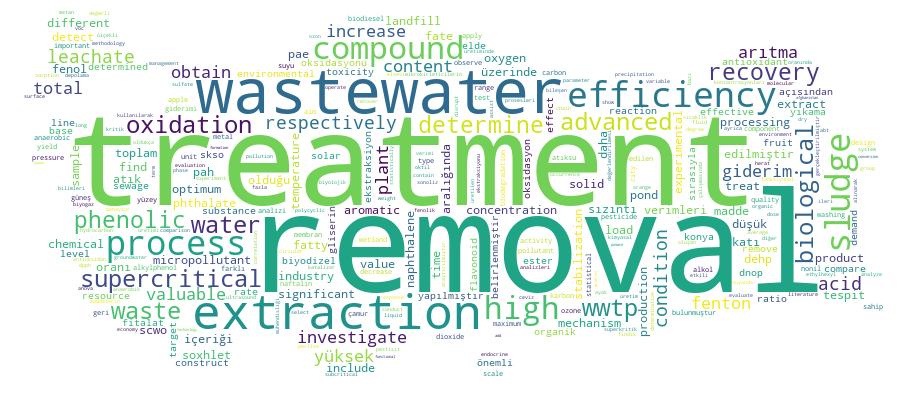
Competency Cloud