Profile URL: https://hdl.handle.net/20.500.13091/11619
Job Title:Doç. Dr.
Email Address:smdemet@ktun.edu.tr
Main Affiliation:02.10. Department of Mechanical Engineering
Status: Current Staff
ORCID: 0000-0002-9795-0939
Scopus ID: 56635854700
YÖK Akademik: 0BF7A9249F82892E
Google Scholar: cK4MFUAAAAAJ
Web of Science ID: OOM-2476-2025
Name Variants:
Demet, S. Mehmet Demet, Seyit M.
16 results
Scholarly Output Search Results
Now showing 1 - 10 of 16
Article Citation - WoS: 7Citation - Scopus: 7Solid Particle Erosion Behavior on the Outer Surface of Basalt/Epoxy Composite Pipes Produced by the Filament Winding Technique(MDPI, 2023) Demet, Seyit Mehmet; Sepetcioğlu, Harun; Bagci, MehmetBasalt/epoxy composite pipes in a [+/- 55](4) winding configuration were produced on CNC filament winding machines (10 N fiber tension and similar to 11 mm bandwidth). In the experiments, a 34 m/s impact velocity was set using the double-disc method, and five different particle impingement angles (30, 45, 60, 75, and 90 degrees) were used to determine the erosive effect on the outer surfaces of filament wound composite pipes under the influence of 600 mu m erodent particles with angular geometry in the test set, complying with the ASTM G76-95 standard. The winding patterns in the lamina (+/- 55 angle-ply laminate region) and zigzag (+/- 55 zigzag region) regions of BFR/EP pipes were determined to have significant effects on solid particle erosion resistance, as evidenced by the SEM images.Article Citation - WoS: 1Citation - Scopus: 1Synergistic and Antagonistic Effects of Hybridization and MWCNT Reinforcement on the Solid Particle Erosion of Glass/Carbon Fiber Composites(MDPI, 2025-09-09) Demet, Seyit MehmetA systematic investigation into the solid particle erosion (SPE) of monolithic, sandwich-type hybrid and multi-scale (Multi Wallet Carbon Nanotube (MWCNT)-reinforced) glass/carbon fiber composites was performed confirming to the ASTM G76-18 standard, utilizing angular alumina erodent (similar to 600 mu m) at 34 m/s across key impingement angles of 30 degrees, 45 degrees, 60 degrees, and 90 degrees. The analysis reveals a profound performance dichotomy dictated by the governing wear mechanism. At the shear-dominated 30 degrees angle, where maximum material loss was observed, hybridization consistently enhanced erosion resistance relative to both monolithic benchmarks. This synergy, however, contrasts sharply with the nuanced behavior under the 90 degrees impact-dominant regime; here, although strategically hybridizing a brittle CFRP with tougher glass fibers reduced the erosion rate (ER) by a remarkable similar to 50%, this benefit was compromised by the matrix embrittlement induced by MWCNT incorporation. This work clarifies the difference between shear-dominated erosion in the ductile regime and fracture toughness under impact-dominated conditions.Article Citation - WoS: 1Citation - Scopus: 1Influence of Temperature and Stress Ratio on Low-Cycle Fatigue Life Prediction of UD-CFRCs Considering Stiffness Degradation(Wiley, 2025) Demet, Seyit Mehmet; Demir, OkanThis study explores the feasibility of stress-based and residual-strength-based methodologies for fatigue life prediction of unidirectional carbon fiber-reinforced composites (UD-CFRCs) under low-cycle fatigue (LCF) loading. The influence of temperature and stress ratio on stiffness degradation is also investigated. Stiffness degradation increased with increasing temperature, resulting in reduced fatigue life. Similarly, higher stress ratios accelerated stiffness degradation in the UD-CFRCs. However, increasing stress ratios also prolonged Stage II, the cumulative damage progression phase, consequently increasing fatigue life. To evaluate predictive capabilities, two distinct LCF failure models were employed: one based on the Basquin equation and the other on residual strength. These models were applied across three temperatures and four stress ratios, and their results compared. The Basquin equation-based model provided better agreement with experimental observations.Other Effect of Graphene Nanoplatelets on Erosion Behavior of Basalt Fiber-Reinforced Polymer Composite Pipes Under High Temperatures(2025) Demirci, Musa; Sepetçioğlu, Harun; Demet, Seyit Mehmet; Bağcı, MehmetArticle Investigation of the Effect of Hardness on Gear Tooth Failure by Bending Fatigue Test(2022) Demet, Seyit Mehmet; Ersoyoğlu, Ali SerhatThis study investigated the effect of hardness change on the types of damage caused by fatigue damage at the symmetrical and asymmetrical gear teeth made of AISI 4140 material. In the experimental study, gear teeth were subjected to load by the Single Tooth Bending Fatigue (STBF) test method. The gear teeth were loaded with different torque values to examine the fatigue damage. Damages in symmetrical gears happened as a result of the progression of cracks in the tooth root region. In asymmetric gears, on the other hand, it has been observed that the way damage changes rely on the load, the number of cycles, and the hardness. In asymmetrical teeth, relatively high cycle numbers were reached in the tests performed with low torque. The tooth flank damage occurred as a result of crack growth in the teeth at relatively low loads and high cycles.Other Solid Particle Erosion Behaviors of Walnut Shell-Filled (Acrylic-Styrene-Acrylate) [ASA] and (Polycarbonate/Acrylic-Styrene-Acrylate) [PC/ASA] Thermoplastic Blend Biocomposites(2024) Karagöz, İdris; Sepetçioğlu, Harun; Demet, Seyit Mehmet; Bağcı, MehmetArticle Citation - WoS: 7Citation - Scopus: 8An Analysis of the Effect of Pressure Angle Change on Bending Fatigue Performance in Asymmetrical Spur Gears(SAGE PUBLICATIONS LTD, 2021-06-28) Demet, Seyit Mehmet; Ersoyoğlu, Ali SerhatIn this study, the fatigue performances of symmetrical and asymmetrical spur gears were analyzed by performing single tooth bending fatigue tests. The gears tested were determined to be symmetrical spur gears with a 20 degrees/20 degrees pressure angle, asymmetrical spur gears with a 20 degrees/22 degrees pressure angle, and asymmetrical spur gears with a 20 degrees/25 degrees pressure angle. These gears were made of AISI 4140 material. Single tooth bending fatigue tests were performed under variable loads. Considering the tests performed at the same torque values in asymmetrical spur gears with a 20 degrees/22 degrees pressure angle compared to symmetrical spur gears with a 20 degrees/20 degrees pressure angle, a statistically significant increase in performance was achieved at close to 90%. While gears with 20 degrees/20 degrees and 20 degrees/22 degrees pressure angles break at the tooth root, tooth flank fracture was observed in relatively high numbers of cycles in asymmetric spur gears with a 20 degrees/25 degrees pressure angle. It was observed that the formation of tooth flank damage negatively affected the fatigue performance.Article Erosive Wear Behavior of FRP Composite Pipes Under Varying Impingement Angles, Impact Velocities and Flow Directions(Elsevier Sci Ltd, 2026) Demet, Seyit Mehmet; Kepir, Yusuf; Gunoz, Alper; Sepetcioglu, Harun; Bagci, Mehmet; Kara, MemduhFiber-reinforced polymer (FRP) composite pipes are emerging as superior alternatives in sectors such as oil and gas, chemical processing, and aerospace, owing to their high strength-to-weight ratio, corrosion resistance, and design flexibility; however, their long-term durability is susceptible to erosion wear when exposed to abrasive particles. This study experimentally investigates the solid particle erosion (SPE) behavior of filament-wound carbon (CFR/EP), glass (GFR/EP), and basalt (BFR/EP) fiber-reinforced epoxy pipes by ASTM G76-18. Tests were conducted under varied impingement angles (30 degrees, 45 degrees, 60 degrees, 90 degrees), flow directions (axial and radial), and particle velocities (28 and 34 m/s), using both erosion rate (ER) and volumetric material loss to assess performance. All composites demonstrated a semi-ductile erosion response, with degradation consistently peaking at a 45 degrees impingement angle across all test conditions. An increase in particle velocity from 28 to 34 m/s induced a near two-fold escalation in ER. Among the materials, BFR/EP exhibited the highest erosion rates, whereas CFR/ EP was the most resistant. Notably, ER values were consistently higher in the axial flow direction, exceeding radial values by 20-40 % under the most severe condition (45 degrees at 34 m/s). Paradoxically, despite its lower ER, CFR/EP suffered greater volumetric material loss than GFR/EP, a discrepancy attributed to its significantly lower fiber volume fraction (42.4 %) compared to GFR/EP (68.9 %) and BFR/EP (59.7 %). These findings emphasize that both ER and volumetric loss are critical metrics for designing thin-walled pipes, thereby providing a crucial scientific basis for material selection in environments characterized by erosive, multi-directional flow.Doctoral Thesis Asimetrik Düz Dişli Çarkların Eğilme Gerilmeleri Altında Yorulma Performansının Deneysel Olarak İncelenmesi(Konya Teknik Üniversitesi, 2019) Demet, Seyit Mehmet; Ersoyoğlu, Ali SerhatBu tez çalışmasında, deneysel olarak simetrik ve asimetrik dişli çarkların eğilme gerilmeleri altında tek diş yorulma performans analizi çalışmaları yapılmıştır. Literatürde asimetrik dişli çarklar ile ilgili teorik çalışmalar ve sonlu elemanlar metodu ile yapılan analiz çalışmaları bulunmaktadır. Asimetrik dişli çarklar ile ilgili, diş dibi gerilmesinde elde edilen azalmanın yorulma performansına etkisinin deneysel olarak araştırılması noktasında teorik çalışmaları doğrulayıcı yeterli çalışma bulunmamaktadır. Bu çalışmada, simetrik ve asimetrik düz dişli çarkların tek diş eğilmeli yorulma kırılması testleri yapılarak dişli çark dişlerinin yorulma performansları analiz edilmiştir. Diş dibi bölgesinde oluşan kritik gerilme hesapları literatürde kullanılan yaklaşımlar referans alınarak yapılmıştır. Deneysel çalışmaları gerçekleştirmek için özgün bir deney seti tasarlanmış ve AISI 4140 malzemeden imal edilen dişli çarklar bu test aparatında test edilmiştir. Test edilen dişli çarklar; 20°/20° kavrama açısına sahip simetrik düz dişli çarklar, 20°/22° kavrama açısına sahip asimetrik düz dişli çarklar ve 20°/25° kavrama açısına sahip asimetrik düz dişli çarklar olarak belirlenmiştir. Simetrik ve asimetrik dişli çarkların sadece test edilecek dişleri çark üzerinde bırakılıp diğer dişler kaldırılarak imal edilen dişler testlerde kullanılmıştır. Deneylerde, dişli çarklarda en yüksek yük uygulama bölgesi olan tek diş üst temas noktasından, belirlenen yükler uygulanarak diş dibinde gerilmeler oluşturulmuş ve değişken gerilmeler altında yorulma testleri yapılmıştır. Tek diş eğilmeli yorulma kırılması test sonuçları hem tork hem de diş dibi gerilmesi baz alınarak grafikler halinde sunulmuştur. Test sonuçlarına göre asimetrik dişlerin yorulma dayanımında ciddi artış elde edilmiştir. 20°/22? kavrama açısına sahip asimetrik düz dişli çark dişlerinde 20°/20° kavrama açısına sahip simetrik düz dişli çark dişlerine göre aynı tork değerlerinde yapılan testler dikkate alındığında istatistiksel olarak % 90'a yakın performans artışı elde edilmiştir. 20°/25° kavrama açısına sahip asimetrik düz dişli çark dişlerinde nispeten yüksek çevrim sayılarında diş yanak hasarı oluştuğu gözlenmiştir. Diş yanak hasarı oluşumunun yorulma performansını olumsuz etkiledi tespit edilmiştir. Deneysel çalışmalar sonucunda, dişli çark dişlerinde kavrama açılarındaki küçük değişimlerin eğilme gerilmeleri altında yorulma performansına ve diş hasarı oluşma şekillerine etkileri belirlenmiştir. Tek diş eğilmeli yorulma kırılması deney sonuçları istatistiksel olarak değerlendirilmiş ve asimetrik dişlerin yorulma dayanımında artış tespit edilmiştir.Article Grafen Nanoplaka Katkılı Bazalt Elyaf Takviyeli Kompozit Boruların İç Yüzey Erozif Aşınma Direncinde Aşındırıcı Partikül Hızının Rolünün İncelenmesi(2023) Demet, Seyit MehmetBu çalışmada [±55]4 sarım konfigürasyonunda filament sarım tekniği ile imal edilen iki farklı kompozit borunun boru içi malzeme akşının olduğu alt yapı ve malzeme aktarım uygulamalarında erozif aşınmaya maruz kalabilecek boru iç yüzeyinin erozyon davranışı dikkate alınarak araştırılmıştır. Bazalt elyaf takviyeli kompozit boru (BETKB) ile ağırlıkça %0,25 grafen nanoplakalar ile güçlendirilmiş bazalt elyaf takviyeli kompozit boruların (GNP/BETKB) katı partikül erozyon davranışları yapılan deneylerden elde edilen sonuçlar dikkate alınarak karşılaştırılmıştır. Dört farklı çarpma hızında (23 m/s, 28 m/s, 34 m/s, 53 m/s) ve üç farklı çarpma açısında (30, 45, 60) alümina aşındırıcı partiküller boru iç yüzeyine çarptırılarak elde edilen erozyon oranı değerlendirildiğinde grafen nanoplaka takviyesinin bazalt elyaf takviyeli boruda erozyon aşınmasına karşı direnci artırdığı görülmüştür. Erozyon oranının oransal değişiminin de incelendiği grafiklerde de sunulduğu üzere 28 m/s çarpma hızında %50’ye yakın bir erozyon oranı azalımı grafen nanoplaka takviyesi sayesinde elde edilmiştir. Her iki borunun aşınma modelinin yarı sünek aşınma modeline uygun bir davranış sergilediği belirlenmiştir.
Research Topics
Domains
Physical Sciences
Fields
Environmental ScienceEngineeringMaterials Science
Subfields
Ecological ModelingMechanical EngineeringMaterials ChemistryOcean EngineeringMechanics of Materials
Specific Research Areas
Erosion and Abrasive Machining
Gear and Bearing Dynamics Analysis
High-Velocity Impact and Material Behavior
Particle Dynamics in Fluid Flows
Metal and Thin Film Mechanics
Sustainable Development Goals
 9
INDUSTRY, INNOVATION AND INFRASTRUCTURE
3
Research Products

Documents
11
Citations
38
h-index
4

Documents
10
Citations
67
Publication Collaboration
| Affiliation Name | Count |
|---|---|
| Konya Technical University | 13 |
| Selçuk University | 8 |
| Yalova University | 2 |
| KTO Karatay University | 2 |
| Mersin Üniversitesi | 1 |
1 / 2
Data obtained from OpenAlex
| Journal | Count |
|---|---|
| Polymer Composites | 3 |
| Polymers | 2 |
| ECF22 - LOADING AND ENVIRONMENTAL EFFECTS ON STRUCTURAL INTEGRITY | 2 |
| PROCEEDINGS OF THE INSTITUTION OF MECHANICAL ENGINEERS PART L-JOURNAL OF MATERIALS-DESIGN AND APPLICATIONS | 1 |
| Research Square | 1 |
Current Page: 1 / 3

Scholarly Output
16
Articles
11
Views / Downloads
39/98
Supervised MSc Theses
0
Supervised PhD Theses
1
WoS Citation Count
29
Scopus Citation Count
34
Patents
0
Projects
0
WoS Citations per Publication
1.81
Scopus Citations per Publication
2.13
Open Access Source
12
Supervised Theses
1
Scopus Quartile Distribution
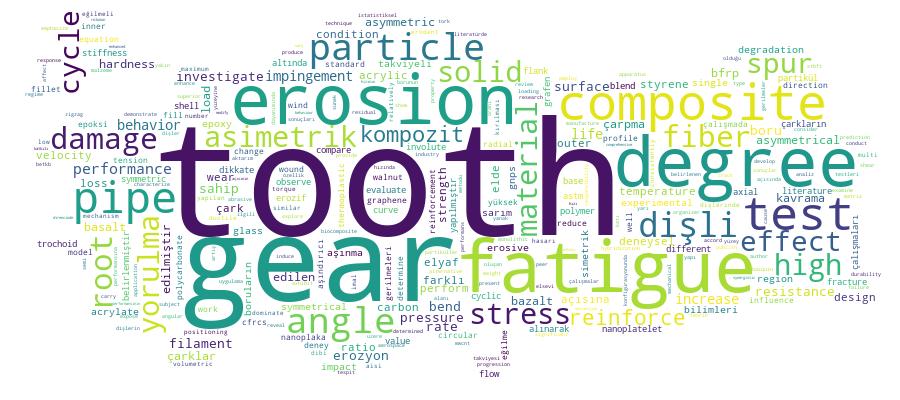
Competency Cloud