Profile URL: https://hdl.handle.net/20.500.13091/11886
Job Title:Doç. Dr.
Email Address:vyilmaz@ktun.edu.tr
Main Affiliation:02.02. Department of Civil Engineering
Status: Current Staff
ORCID: 0000-0002-5407-860X
Scopus ID: 57201021510
YÖK Akademik: 0470D6D5DFB107B1
Google Scholar: g5I-xS0AAAAJ
Web of Science ID: DZF-7400-2022
Name Variants:
Yilmaz, Volkan
21 results
Scholarly Output Search Results
Now showing 1 - 10 of 21
Conference Object Comparative Performance Analysis of Artificial Bee Colony Optimization Algorithm Over Hanoi Water Distribution Network(2019) Yılmaz, Volkan; Büyükyıldız, MeralWater Distribution Networks (WDNs) are crucial structures for urban life. Necessary water for customers is delivered by these structures. Design of WDNs has different conditions and selection interval of commercial pipe sizes and types are very large in today's pipe technologies. Besides, WDNs are very expensive structures and their investment rates are very high over the total project cost. These situations have made the design harder and optimization processes have become a necessity under these situations. Different optimization algorithms have been tried in this study field with the innovation of the computer technologies for nearly 50 years. In this study, performance of Artificial Bee Colony optimization algorithm over WDNs has been studied over the Hanoi WDN as a benchmark problem. Results of a study that was presented in 2010 in a conference has been preferred to make the comparison possible. Same conditions were created and comparison of these studies was realized. Finally it was observed that the Artificial Bee Colony optimization algorithm performed better near the other algorithms.Article Determination of Position of Hydraulic Jump in a Flume by Using Cfd and Comparison With Experiential Results(2020) Yıldız, Ali; Martı, Ali İhsan; Yarar, Alpaslan; Yılmaz, VolkanDams and hydraulic structures are used for the supply and control of water, which have great importance on human life. The sluice gate is one of the hydraulic control structures. Sluice gates release excess water from the reservoir to the downstream side in a controlled manner with a certain discharge for controlling the level of the reservoir. A hydraulic jump is created to dissipate the energy of flow coming from under the gates. A hydraulic jump occurs when the flow regime is changed from subcritical to supercritical. However, the position of the hydraulic jump in the channel should be known exactly to prevent damage to surrounding structures. In this study, an open channel system with a sluice gate is used to produce a hydraulic jump. Experiments are conducted for two different gate openings (a1=1.5 cm and a2=2 cm) and 16 discharge values. For each case, the position of the hydraulic jump is determined. In addition, flow depths at 5 different points were measured including before and after the hydraulic jump. The results obtained from the experimental study were compared with the numerical model in terms of the position of hydraulic jump and flow depths. According to the results obtained, the numerical model and the physical model showed between 80 and 91% consistency.Article Determination of Position of Hydraulic Jump in a Flume by Using CFD and Comparison with Experiential Results Https://Doi.Org/10.21698/Rjeec.2020.211 P(2020) Martı, Ali İhsan; Yarar, Alpaslan; Yıldız, Ali; Yılmaz, VolkanDams and hydraulic structures are used for the supply and control of water, which have great importance on human life. The sluice gate is one of the hydraulic control structures. Sluice gates release excess water from the reservoir to the downstream side in a controlled manner with a certain discharge for controlling the level of the reservoir. A hydraulic jump is created to dissipate the energy of flow coming from under the gates. A hydraulic jump occurs when the flow regime is changed from subcritical to supercritical. However, the position of the hydraulic jump in the channel should be known exactly to prevent damage to surrounding structures. In this study, an open channel system with a sluice gate is used to produce a hydraulic jump. Experiments are conducted for two different gate openings (a1=1.5 cm and a2=2 cm) and 16 discharge values. For each case, the position of the hydraulic jump is determined. In addition, flow depths at 5 different points were measured including before and after the hydraulic jump. The results obtained from the experimental study were compared with the numerical model in terms of the position of hydraulic jump and flow depths. According to the results obtained, the numerical model and the physical model showed between 80 and 91% consistency.Conference Object Investigation of Variables That Affect the Urban Water Consumptıon Over Some Districts of Konya City(2019) Ebad, Omidullah Zein; Yılmaz, VolkanAs it is known, the importance and consumption of water are increasing day by day due to industrial growth, population growth, advancement of technology and increasing living standards. Because of the limited water resources, the design, planning, forecasting of water transmission and distribution systems should be made more carefully and the water resources should be used more efficiently. In this context, the importance of the factors affecting water demand is increasing day by day. Population, economic cycles, education, technology, climatic conditions, price, and many other factors have their effects on water consumption. By designating these effects in a healthy and reliable way, it is possible to design systems that are more reliable and to use water resources more efficiently. In the present study, by using water consumption data of 4 different neighborhoods of the central districts of Konya with different characteristics, the effects of meteorological variables on water consumption according to the characteristics of neighborhoods were investigated by using Multiple Regression Analysis.Book Part Performance Analysis of Metaheuristic Optimization Algorithms for a Real Water Distribution Network(Eğitim Yayınevi, 2024) Yılmaz, Volkan; Büyükyıldız, Meral; Baykan, Ömer Kaan; Kamanlı, MehmetArticle Citation - WoS: 3Citation - Scopus: 3An Approach on the Estimation and Temporal Interaction of Runoff: the Band Similarity Method(Iwa Publishing, 2024-08-30) Yılmaz, Volkan; Koyceğiz, Cihangir; Büyükyıldız, MeralThis study is based on the investigation of the performance of the band similarity (BS) method, which is quite new in the literature, in the prediction of flow and in determining the memory properties of the flow phenomenon. For this purpose, flow prediction models for the monthly flow data of the Sar & imath;z station, located in the Seyhan Basin in T & uuml;rkiye, were produced first with the particle swarm optimization (PSO) algorithm. Second, these models were used in the BS method to create the BSPSO approach. Then, flow prediction was made for the same data set with support vector regression (SVR). In the test period, the standalone PSO, BSPSO, and SVR models achieved the most successful Nash-Sutcliffe efficiency (NSE) values of 0.516, 0.691, and 0.659, respectively. As a result, it was seen that BS increased the success of PSO by approximately 35% and the BSPSO produced the best results (mean absolute error = 1.205 m(3)/s, root mean square error = 1.895 m(3)/s, NSE = 0.691, and R-2 = 0.734). With the BSPSO approach, it has been observed that there is a memory mechanism within the flow phenomenon. It was concluded that the 5-month variation played an important role in the memory and a stronger memory existed especially in water years when low flow values were observed.Article Cost Optimization of Hanoi Water Distribution Netvvork With Meta- Heuristic Optimization Algorithms(2019) Yılmaz, Volkan; Büyükyıldız, Meral; Baykan, Ömer KaanWater transfer and distribution systems have high-cost values in a process from the collection of required water to the delivery by end-users. Besides the existence of few options for water transmission systems, there are more possible Solutions for water distribution systems which have to require necessary conditions. Defining the best system which has minimum cost value for a water distribution system has been an optimization problem in time. Different optimization algorithms have been revealed with the help of the innovation of Computer technologies and these algorithms were used in cost optimization of water distribution network field and performance of algorithmshave been evaluatednearly for 50 years. Inthis study, Partide Swarm Optimization (PSO) and Genetic Algorithm (GA) methods, commonly used in the literatüre, and recently revealed Artificial Bee Colony (ABC) algorithm method were applied to Hanoi water distribution network for the purpose of cost optimization. T o determine the bestperforming algorithm for this case study; the comparative performance analysis of convergence velocity, stability, and distribution of results were evaluated.Article Particle Swarm Optimization-Based Determination of Hydraulic Jump Location in Sluice Gate Flows(Konya Teknik University, 2025) Yilmaz, Volkan; Yıldız, AlıThe hydraulic jump is a critical phenomenon in open channel hydraulics, and understanding its behavior is essential for the design and safety of hydraulic structures. In this study, 96 experiments were conducted using five different gate openings to model the location of hydraulic jumps in an open channel. The Particle Swarm Optimization (PSO) algorithm, a metaheuristic optimization technique, was employed to develop both linear and nonlinear predictive models. Experimental data from gate openings (e) of 2.5 cm, 3.5 cm, 4 cm, and 5 cm were used to train the models, while data from a e=6 cm gate opening were used for testing. The results demonstrated that the PSO algorithm effectively modeled the hydraulic jump location, yielding high accuracy and consistency with experimental observations. Model performance was evaluated using the Coefficient of Determination (R²), Nash-Sutcliffe Efficiency (NSE), and Mean Squared Error (MSE). The linear model outperformed the nonlinear model, achieving NSE = 0.954, R² = 0.983, and MSE = 0.022. Furthermore, the upstream total head (H) and gate opening (e) were identified as the most influential parameters affecting the hydraulic jump location.Conference Object Estimation of Position of Hydraulic Jump in an Open Channel by Numerical Modeling and Comparision With Experimental Results(2019) Yıldız, Ali; Martı, Ali İhsan; Yılmaz, VolkanA flow passing under a sluice gate is generally in supercritical regime in open channels. If the regime of the flow is changed from supercritical to subcritical by a step or contraction, a hydraulic jump occurs. Although a hydraulic jump act as an energy dissipater, an uncontrolled or unpredicted hydraulic jump can damage hydraulic structures. Therefore, determination of parameters such as position of hydraulic jump, flow depths at subcritical and supercritical phases has great importance. Computational fluid dynamics are used to predict behavior of flow in open channels, but the accuracy of these results should be tested. In this study, a simple open channel system is used in order to investigate behavior of hydraulic jump and determine position of it. The regime of the flow passing through the sluice gate is changed to subcritical flow by a step which placed after sluice gate and a hydraulic jump is formed. Position of hydraulic jump, flow depths and flow velocities are measured for 2 different gate openings and 40 different discharge values. Numerical model of the physical experiment is created in same dimensions and initial conditions by Ansys-Fluent. Results of numerical and physical models are compared. According to results, CFD programs are sufficiently advanced to simulate a hydraulic jump.Book Part Medium-Term Effects of Covid-19 Pandemic on Domestic Water Consumption: a Case Study(Eğitim Yayınevi, 2024) Yılmaz, Volkan; Kamanlı, Mehmet
- «
- 1 (current)
- 2
- 3
- »
Research Topics
Domains
Physical Sciences
Fields
EngineeringEnvironmental Science
Subfields
Civil and Structural EngineeringEnvironmental EngineeringOcean EngineeringElectrical and Electronic EngineeringWater Science and Technology
Specific Research Areas
Water Systems and Optimization
Hydrological Forecasting Using AI
Water resources management and optimization
Energy Load and Power Forecasting
Hydrology and Watershed Management Studies
Sustainable Development Goals
 11
SUSTAINABLE CITIES AND COMMUNITIES
4
Research Products
 6
CLEAN WATER AND SANITATION
2
Research Products
 3
GOOD HEALTH AND WELL-BEING
1
Research Products

Documents
8
Citations
117
h-index
4

Documents
9
Citations
109
Publication Collaboration
| Affiliation Name | Count |
|---|---|
| Konya Technical University | 8 |
| Ondokuz Mayıs University | 1 |
1 / 1
Data obtained from OpenAlex
| Journal | Count |
|---|---|
| Niğde Ömer Halisdemir Üniversitesi Mühendislik Bilimleri Dergisi | 2 |
| Konya Journal of Engineering Sciences | 1 |
| Ömer Halisdemir Üniversitesi Mühendislik Bilimleri Dergisi | 1 |
| Physics and Chemistry of The Earth | 1 |
| Romanian Journal of Ecology & Environmental Chemistry | 1 |
Current Page: 1 / 3

Scholarly Output
21
Articles
12
Views / Downloads
49/48
Supervised MSc Theses
2
Supervised PhD Theses
0
WoS Citation Count
19
Scopus Citation Count
20
Patents
0
Projects
0
WoS Citations per Publication
0.90
Scopus Citations per Publication
0.95
Open Access Source
13
Supervised Theses
2
Scopus Quartile Distribution
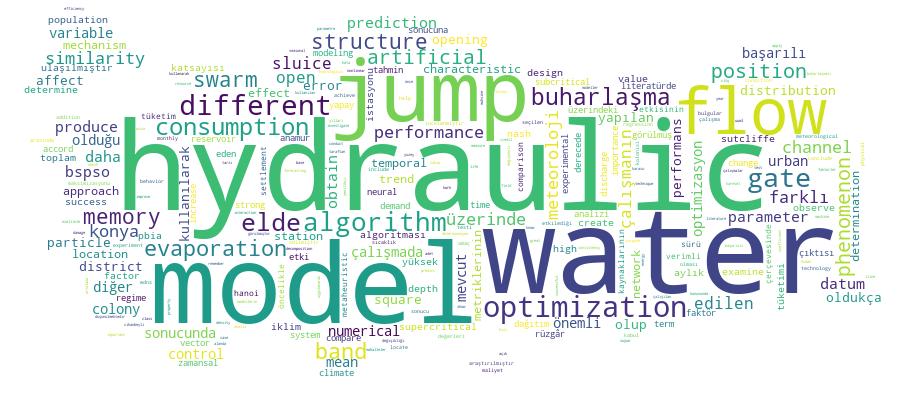
Competency Cloud