Profile URL: https://hdl.handle.net/20.500.13091/11648
Job Title:Prof. Dr.
Email Address:sedebali@ktun.edu.tr
Main Affiliation:02.01. Department of Chemical Engineering
Status: Current Staff
ORCID: 0000-0002-2098-580X
Scopus ID: 35760236600
YÖK Akademik: 87C774CF8BE364D5
Google Scholar: 7bvfdk0AAAAJ
Web of Science ID: AAP-8547-2020
Name Variants:
Edebalı, Serpil Edebali, S.
30 results
Scholarly Output Search Results
Now showing 1 - 10 of 30
Article Citation - WoS: 2Citation - Scopus: 3Parabolic Trough Concentrator Design, Characterization, and Application: Solar Wastewater Purification Targeting Textile Industry Dyes and Pharmaceuticals-Techno Study(Springer Heidelberg, 2024-05-08) El Golli, Asma; Fendrich, Murilo; Bajpai, Om Prakash; Bettonte, Marco; Edebalı, Serpil; Orlandi, Michele; Miotello, AntonioSolar energy, along with other renewable resources, has the potential to be a major contributor to solving environmental issues in the future, as illustrated by the most recent advancements in solar photocatalytic technology. Indeed, wastewater treatment using a parabolic solar collector for industrial processes is gaining ground owing to improved system performance and economic benefits. The fabricated parabolic trough collector (PTC) incorporates reflective, parabolic panels that focus solar energy onto a transparent tube positioned along the parabolic focal line, where solar-powered photochemical reactions occur. This study investigated the design, implementation, and effectiveness of a concentrated sunlight system for removing industrial dyes and emerging large-use pharmaceutical contaminants in the presence of H2O2 at a small demonstrator scale (10 L/h). A spectrophotometric assessment revealed that subjecting Remazol Brilliant Blue (RBB, 60 ppm) and ciprofloxacin (CIP, 10 ppm) to irradiation in the presence of 0.1 M H2O2 (RBB) or 0.01 M H2O2 (CIP) for 3 h resulted in a degradation rate exceeding 60% and 80%, respectively. Furthermore, the total organic content (TOC) analysis indicates a very high total removal yield for RBB. On these bases, a techno-economic analysis is produced, and economic viability is discussed. The data reveal that the annual costs for water treatment, considering investment, electricity, and catalyst expenses over a 12-month period are significantly lower for our PTC-based prototype than for a comparable artificial UV-based equipment.Article Preparation and Characterisation of Fe3o4@sio2@mtx@lipid Nanoparticles as a Controlled Drug-Delivery System(Inderscience Publishers, 2020) Yılmaz, N.; Edebali, S.; İçduygu, M.G.In this study, synthesis and characterisation of mesoporous, super magnetic silica with controlled release methotrexate ability were aimed for treatment of rheumatoid arthritis. Within this scope, magnetite nanoparticles were synthesised by coprecipitation method and surfaces of these nanoparticles were coated with mesoporous silica and phospholipid layers. FT-IR, XRD, VSM, BET, TEM, EDX and FESEM analyses were performed for characterisation. The results of FT-IR analysis show the existence of silica and lipid layers around magnetite. Fe3O4@SiO2nanoparticles have a surface area of 576.69 m2/g, a pore size of 8.21 nm and a mesoporous structure. XRD analyses indicate that the synthesised Fe3O4 and Fe3O4@SiO2nanoparticles have cubic spinel structures. FESEM images show that nanoparticles have spherical shape and VSM analysis indicates that nanoparticles have superparamagnetic characteristic. © 2020 Inderscience Enterprises Ltd.. All rights reserved.Conference Object Adsorption Properties of Red Mud, Bauxite and Red Soils in Seydişehir (konya)? Akseki (antalya) Region(2023) Çelik Karakaya, Muazzez; Karakaya, Necati; Ruşen, Aydın; Ölçer, Derya; Edebali, SerpilConference Object Kırmızı Çamurdan Bazı Ana Element Oksitlerin Geri Kazanılması (seydişehir- Konya, Türkiye)(2022) Çelik Karakaya, Muazzez; Ruşen, Aydın; Karakaya, Necati; Öztürk, Alican; Edebali, SerpilSeydişehir (Konya) - Akseki (Antalya) arasında farklı rezervlerde boksit yatağı (Doğankuzu, Mortaş, Morçukur, Değirmenlik, Kaklıktaş, Çukurkuyu, vb.) veya çökeli bulunmaktadır. Söz konusu bölgede boksit işletmesi 1970 yılında başlamış ve bazı yataklarda halen sürdürülmektedir. Genel olarak bir ton alümina elde edilirken 0.8-1.5 ton kırmızı çamur boksitin kimyasal bileşimine bağlı olarak atılmaktadır. Boksite kireç ilave edilerek veya edilmeden de alümine elde edilme işlemi yapılmakta ve oluşan atık yapay göle bırakılmaktadır. Her iki kırmızı çamurun da ana mineral hematittir. Perovskit, anataz ve rutil titanyum minerallerri olarak tespit edilmiştir. Kireçli veya kireçsiz kırmızı çamurun element içerikleri değişmekle birlikte önemli miktarlarda Fe2O3, Al2O3, Na2O, SiO2, CaO ve TiO2 yanında ekonomik önemi fazla olan Sc, Y, Ga, V ve NTE gibi kritik elementleri de içermektedir. Özellikle Fe2O3 içeriği sırayla kireçli ve kireçsiz atıklarda sırayla 32.76-32.97 ve 23.33-26.58% arasında değişirken, TiO2 içeriği 5.05-5.06 ve 3.50-3.98 % arasında belirlenmiştir. Farklı kırmızı çamur numunelerinden hazırlanan stok numunede liç deneyleri yapılmıştır. Kırmızı çamurun içeriğindeki ana element oksit ve iz elementlerin geri kazanılması için çeşitli liç deneyleri uygulanmıştır. Zenginleştirme işlemlerinde Doğrudan Liç ve Sülfasyon-Kavurma-Liç yöntemi şeklinde iki farklı yöntem uygulanmıştır. Doğrudan Liç deneyleri 1M - 4M derişim aralığında, 25 ºC – 95 ºC sıcaklık aralığında, 1/40 - 1/10 katı/sıvı oranlarında ve farklı sürelerde (60-480 dk) ve üç farklı asit (H2SO4, HCl, HNO3) kullanılarak gerçekleştirilmiştir. Yapılan liç deneyleri sonucunda bazı elementlerin geri kazanım oranları daha yüksek bulunmuştur. Özellikle Fe2O3 ve TiO2 gibi ekonomik önemi fazla olan elementlerde ise farklı asit türlerinde benzer sonuçlar alınmıştır ve bu elementlerin geri kazanım oranları %40-60 arasında kalmıştır. Özellikle önemli bir endüstriyel element olan TiO2’in kırmızı çamurdaki içeriği yaklaşık %4,5 olup, ekstraksiyon oranı %50’nin üzerindedir. Bu elementin bu ekstraksiyon oranı yaklaşık bir milyon ton kırmızı çamurdan çok önemli miktarda endüstriyel teknolojiye kazanım sağlayabilir.Article Recovery of La from Red Mud Through Roasting, Water Leaching, and Subsequent Adsorption Processes(Springer, 2026) Choubi, Hanae; Rusen, Aydin; Karakaya, Muazzez Celik; Edebali, Serpil Cetin; Olcer, Derya; Alkan, M. Sami; Karakaya, NecatiRare earth elements (REEs) are critical raw materials due to their rapidly expanding applications. Red mud, a by-product of aluminum production via the Bayer process, represents a promising secondary source of REEs, particularly lanthanum (La). This study investigates the recovery of La from red mud using an integrated sulfating-roasting-water leaching (SRWL) process followed by adsorption. Mineralogical and chemical analyses confirmed that REEs were dispersed within the matrix rather than concentrated in a separate mineral phase. Water leaching studies of treated (sulfation-roasting) red mud at room temperature showed that leaching time was the dominant parameter, and up to 90% REE recovery could be achieved after 96 h. In adsorption studies with leaching solutions obtained under optimum conditions, a commercial ion exchange resin (Lewatit MonoPlus SP112) and bio-based microcapsules (chabazite and chitosan) were evaluated for La removal. The effects of adsorbent dosage, pH, temperature, and contact time were systematically investigated. The results show that the commercial resin provides rapid and almost complete La removal, while the microcapsules exhibit slower kinetics due to their heterogeneous structure. Overall, the integrated SRWL-adsorption approach provides an effective way to enrich REEs and recover La from red mud, highlighting the potential for the utilization of industrial wastes.Article Citation - WoS: 1Exploring Mil-53 (al) Adsorption Efficiency for Indigo Carmine Dye(Konya Teknik Univ, 2024) Yanardağ Kola, Duygu; Edebalı, Serpil; Kola, Duygu YanardagSynthetic dyes are extensively used in industrial areas, including plastic, textile, and food. However, they are a major environmental problem due to their negative effects on water quality and living organisms. To address one of these problems, MIL-53 (Al) is served as an adsorbent for removing indigo carmine dye, being widely used in textile industries. The synthesis of MIL-53 (Al) was carried through the hydrothermal method and different synthesis conditions were studied to find the best adsorbent to remove indigo carmine. FTIR, XRD, SEM, and EDS were used to assess materials. Isotherm models and kinetic models were investigated for indigo carmine adsorption, revealing that the Langmuir isotherm model and pseudo-second-order kinetic model provided best fit to data. The highest adsorption capacity was calculated as 145 mg/g. The study contributes valuable insights into the adsorption of indigo carmine by MIL-53 (Al).Article Citation - WoS: 3Citation - Scopus: 3Removal of Hexavalent Chromium (cr6+) From Aqueous Solutions by Chitosan-Halloysite Nanotubes Composite Hydrogel Beads(Bentham Science Publishers, 2025-02-01) Edebali, S.; Kahraman, H.T.; Karakaya, M.Ç.Background: In recent years, low-cost biomaterials have been used for sustainable applications to reduce the impact of wastewater treatment. The preparation of bio-based materials with a strong affinity for chromate plays a crucial role in the adsorption process. Methods: In this study, chitosan-halloysite nanotubes composite hydrogel beads (Ch-HNTs) were prepared for the removal of hexavalent chromium (Cr6+) from aqueous solutions. Ch-HNTs hydrogel beads were generated by incorporating HNTs into chitosan using a glutaraldehyde solution to achieve efficient crosslinking. The structure of the Ch-HNTs was characterized by SEM and FTIR analysis. These novel adsorbents were then tested for the adsorption of Cr6+ in serial batch experiments. For this purpose, the effect of pH, contact time, temperature, concentration of adsorbate, and adsorbent concentration on the extent of adsorption were investigated. Results: The adsorption rate for Cr6+ was maximum at an initial pH of 2 in 60 minutes of contact time. The experimental data were fitted to Langmuir adsorption isotherm. The adsorption data were fitted to the Langmuir adsorption isotherm. The maximum adsorption capacity of 72.22 mg Cr6+/g for Ch-HNTs was obtained according to the Langmuir adsorption isotherm. Conclusion: It is proposed that Ch-HNTs can be potential adsorbents for Cr6+ removal from dilute solutions. Nonetheless, further studies on adsorbing and removing various heavy metals using these novel beads in column systems can be planned. © 2025 Bentham Science Publishers.Publication Contributors(2021) Acevedo-morantes, María Teresa; Ali, S. Wazed; Ali, Akbar; Ahmed, Shakeel; Akhter, Arifa; Yadav, Anilkumar; Akhtar, GazallaMaster Thesis Menengiç Bazli Biyosorbentlerin Sentezi, Karakterizasyonu ve Sorpsiyon Özelliklerinin İncelenmesi(Konya Teknik Üniversitesi, 2023) Tülek, Beyza; Edebali, SerpilTekstil boyar maddeleri atık sularda bulunan, çevre ve insan sağlığını olumsuz yönde etkileyen kirleticilerdendir. Bu kimyasalların atık sulardan uzaklaştırılması canlı yaşamı için önemlidir. Menengiç iç kabuğundan oluşan toz haline getirilen malzemeyi kitosan ile kapladıktan sonra indigo karmin ve sülfür black olmak üzere iki tane boyar madde üzerinde çalışılmıştır. Bu çalışmada menengiç meyvesinin iç kabuğunun tozu kitosan ile modifiye edilerek mikro kapsül haline getirildi ve sulardan indigo karmin ve sülfür black uzaklaştırılması için kullanıldı. Adsorpsiyon deneyleri sırasında madde miktarı, zaman, konsantrasyon ve sıcaklık parametrelerin etkileri incelendi. Adsorpsiyon prosesinin indigo karmin için 0,04 g madde miktarında dengeye ulaştığı görülmüştür. Adsorpsiyon prosesinin indigo karmin için 120 dakika dengeye ulaştığı gözlemlenmiştir. Aynı zamanda indigo karmin çözelti pH değeri 2, diğer deneylerde sabit tutulmuş ve değiştirilmemiştir. Adsorpsiyon prosesinin sülfür black için 0,04 g madde miktarında dengeye ulaştığı görülmüştür. Adsorpsiyon prosesinin sülfür black için 60 dakika dengeye ulaştığı gözlemlenmiştir. Aynı zamanda sülfür black çözelti pH değeri 2, diğer deneylerde sabit tutulmuş ve değiştirilmemiştir. Çalışmaların son aşamasında, adsorpsiyon dengesinin matematiksel olarak tanımlanmasında Langmuir ve Freundlich adsorpsiyon modelleri kullanıldı ve model sabitleri hesaplandı. Sonuç olarak deneysel verilerin hem indigo carmin çözeltisi hem de sülfür black çözeltisi için Langmuir izoterm modeline uyduğu görülmüştür. Ayrıca kinetik verilerin birinci derece ve ikinci derece kinetik modellere uyumu araştırıldı, her modele ait kinetik sabitler bulunmuştur. Buna göre her iki boyar madde olan indigo karmin ve sülfür black çözeltilerinin ikinci derece kinetik modele daha uygun olduğu sabitlerden görülmüştür. Son olarak her sistem için adsorpsiyon termodinamik sabitleri olan ∆H, ∆S, ∆G termodinamik eşitlikler kullanılarak belirlenmiştir.Article Citation - WoS: 6Citation - Scopus: 5Facile Synthesis of Zeolitic-Imidazole Framework-67 (zif-67) for the Adsorption of Indigo Carmine Dye(John Wiley and Sons Inc, 2024-09-24) Kola, D.Y.; Edebali, S.the authors reviewed and edited the content as needed and took full responsibility for the content of the publication.
- «
- 1 (current)
- 2
- 3
- »
Research Topics
Domains
Physical Sciences
Fields
Environmental ScienceChemistryEngineering
Subfields
Water Science and TechnologyIndustrial and Manufacturing EngineeringOrganic ChemistryMechanical EngineeringInorganic ChemistryWaste Management and Disposal
Specific Research Areas
Adsorption and biosorption for pollutant removal
Water Quality Monitoring and Analysis
Nanomaterials for catalytic reactions
Extraction and Separation Processes
Metal-Organic Frameworks: Synthesis and Applications
Sustainable Development Goals
 6
CLEAN WATER AND SANITATION
5
Research Products
 11
SUSTAINABLE CITIES AND COMMUNITIES
4
Research Products
 3
GOOD HEALTH AND WELL-BEING
3
Research Products
 7
AFFORDABLE AND CLEAN ENERGY
2
Research Products
 9
INDUSTRY, INNOVATION AND INFRASTRUCTURE
2
Research Products
 15
LIFE ON LAND
1
Research Products
 13
CLIMATE ACTION
1
Research Products

Documents
26
Citations
715
h-index
13

Documents
26
Citations
637
Publication Collaboration
| Affiliation Name | Count |
|---|---|
| Konya Technical University | 21 |
| Selçuk University | 16 |
| Necmettin Erbakan University | 7 |
| Giresun University | 2 |
| Consejo Nacional de Investigaciones Científicas y Técnicas | 2 |
1 / 9
Data obtained from OpenAlex
| Journal | Count |
|---|---|
| Konya mühendislik bilimleri dergisi (Online) | 2 |
| Elsevier eBooks | 2 |
| International Journal of Nanoparticles | 2 |
| Applied Organometallic Chemistry | 1 |
| Applied Surface Science Advances | 1 |
Current Page: 1 / 4

Scholarly Output
30
Articles
14
Views / Downloads
76/89
Supervised MSc Theses
1
Supervised PhD Theses
2
WoS Citation Count
135
Scopus Citation Count
152
Patents
0
Projects
0
WoS Citations per Publication
4.50
Scopus Citations per Publication
5.07
Open Access Source
8
Supervised Theses
3
Scopus Quartile Distribution
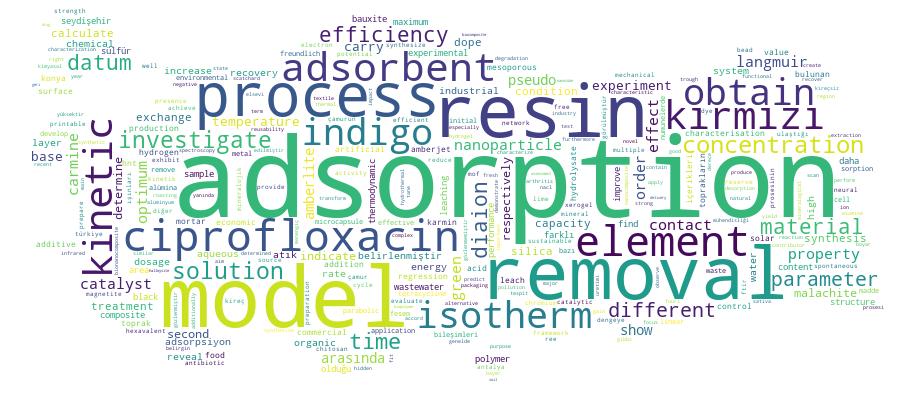
Competency Cloud