Profile URL: https://hdl.handle.net/20.500.13091/11764
Job Title:Prof. Dr.
Email Address:hkurt@ktun.edu.tr
Main Affiliation:02.07. Department of Geological Engineering
Status: Current Staff
ORCID: 0000-0001-7991-2085
Scopus ID: 14068790700
YÖK Akademik: FADFA6752C50F2F5
Google Scholar: tcBhq3AAAAAJ
Name Variants:
Kurt, Huseyin Kurt, Hüseyi̇n
28 results
Scholarly Output Search Results
Now showing 1 - 10 of 28
Book Part Discrimination of the Volcanic Units Using Calibration-Free Laser Induced Breakdown Spectroscopy (cf–libs)(Duvar Publishing, 2021) Gençoğlu Korkmaz, Gülin; Gündoğdu, Yasemin; Kılıç, Hamdi Şükür; Kurt, Hüseyin; Kuş, RecaiConference Object Water and Environmental Effects(ENAR, 2019) Kurt, HüseyinArticle Interpretation of the Magma Chamber Processes With the Help of Textural Stratigraphy of the Plagioclases (konya-Central Anatolia)(2021-04-06) Gençoğlu Korkmaz, Gülin; Kurt, Hüseyin; Korkmaz, Gulin GencogluThe variations in the chemical composition and micro-texture of a mineral from the core to the rim allow the sequencing of the formation of the magma chamber processes and the interpretation of which texture might have been formed by which process. In this contribution, the textural and chemical zoning of the plagioclases, which are a significant recorder of magma chamber processes, from some enclave?containing andesites (calc-alkaline) and basalts (calc-alkaline) from the Karapınar-Karacadağ Volcanic Units, were examined and their textural mineral stratigraphies were investigated to enlight the magma chamber processes. Plagioclases from the andesitic host-rock and their enclaves generally exhibit different composition from core to rim. The composition in the enclave ranges from oligoclase to labradorite (core:An25-72), however, in the host rock it ranges from andesine to labradorite (core:An46-64). It is noteworthy that the plagioclases in the host-rock are mostly rounded, and reverse and oscillatory zoned with Anorthite, Fe, Mg, Sr, and Ba. However in the enclaves they display generally fine sieve and dusty sieve textures. The cores of the plagioclase micro-phenocrysts in calc-alkaline basalts are andesine-labrador (An32-66) in composition. Remarkably, plagioclases in basalts show reverse and oscillatory zoning with An, Fe, Mg, Sr, and Ba, and as well as exhibit coarse-grained sieve texture with glass and microlitic inclusions, and spongy cellular textures. Combined with their An, Fe, Mg contents it is suggested that some of the plagioclases from the basalts may be xenocrysts rather than phenocrysts. Considering the textural and chemical properties of the plagioclases, in the formation of reverse and oscillatory zoning in the basaltic rocks, the decompression processes in addition to the magma mixing processes (magma mixing/self-mixing) also have an impact on the genesis of the basalts. However, in the formation of andesitic rocks, the magma replenishment processes have a key role rather than decompression or temperature-pressure change.Conference Object Petrochemical Stratigraphy of Cumulate Enclave Bearing Andesites From Karapınar-Karacadag Volcanic Complex (konya, Central Anatolia)(GEOSCIENCE, 2020) Gençoğlu Korkmaz, Gülin; Kurt, HüseyinAmphibole and pyroxene major and trace element compositions from the cumulate enclave bearing andesites from the Karapınar - Karacadag Volcanic Complex, in Konya (Turkey), have been analyzed by electron microprobe and laser ablation inductively coupled plasma mass spectrometry. A petrochemical stratigraphy can be interpreted for the rocks by using major and trace element contents of the minerals and their changes from center to rim. Amphibole (GK-35C1) of the cumulate enclave, from core to rim, contains Li = 107-103-112 ppm, Ti = 7760-6120-772 ppm, V = 410-342-415 ppm, Cr = 149-166-249 ppm, Zr = 79-94-88 ppm, Mn = 1764-1961-1726 ppm. However host rock’s amphibole grain (GK-35C6), from core to rim, includes Li = 52-111-97 ppm, Ti = 7760-6120-772 ppm, V = 496-520-351 ppm, Cr = 10-69-11 ppm, Zr = 117-53-50 ppm, Mn = 1790-2723-3300 ppm. Moreover, pyroxene from the host rock has 10.7-8.5-11.6 ppm Li, 1230-658-1933 ppm Ti, 162-114- 202 ppm V, 29-7-1420 ppm Cr, 31-16-42 ppm Zr, 4010-3721-2422 ppm Mn. Amphibole thermobarometer calculations have yielded temperature and pressure estimates 993-915°C and 5-2.17 kbar for enclave and host rock, respectively. Also, clinopyroxene geothermobarometer calculations have given 1.34 kbar pressure and 1116°C temperature. Especially the mineral chemistry data of amphiboles and pyroxenes show that the cumulate enclave is more primitive than its host, and enclave were formed at an earlier stage. Geothermobarometer calculations also indicate that the amphiboles in the enclave was formed at a deeper depth than the pyroxenes in the host and the enclave was broken off during convection in the magma chamber and brought to the host. Oscillatory and reverse zonning in terms of Li, Ti, Zr, Hf, Cr, V contents in the minerals indicate magma replenishment. In the host rock, decreasing in Zr and Hf contents from core to rim shows co-magmatic zircons with the amphiboles. Ti negative anomaly in the amphiboles exhibits that they crystallized after Fe-Ti oxide formation. In the light of the mineral chemistry data, Petrochemical stratigraphy (P) should be as in the bottom. P1) Formation of the amphibole cores in the cumulate enclave, after Fe-Ti oxides formations P2) Recharging of the amphiboles in the enclave, P3) Formation of the host rock’s amphibole cores and crystallization of comagmatic zircons P4) Breaking off the cumulate enclaves with convection and settling in the host rock, while the recharging of the host rock amphiboles, P5) Formation of host rock’s pyroxene cores, P6) recharging of the pyroxenes P7) crystallization of the plagioclase and quartz minerals in the shallow depths of the upper crust.Article Yemişliçay Formasyonu İçindeki (sub)volkanik Birimlerin 40ar/39ar Jeokronolojisi, Mineral- ve Tüm-kayaç Jeokimyası, Sinop Güneyi (orta Pontidler)(Pamukkale Univ, 2020) Asan, Kürşad; Kurt, HüseyinOrta Pontidlerde, Sinop-Samsun çevresinde Geç Kretase-Eosen yaşlı volkanik kayaçlar belirgin yüzlekler vermektedir. Geç Kretase volkanitleri, kuzeyde Sinop yakın civarında Hamsaros Volkanitleri, güneyde ise Alaçam-Dikmen-Durağan çevrelerinde Yemişliçay Formasyonu içindeki volkanik birimler ile temsil edilmektedir. Eosen volkanitleri, Bafra’dan başlayıp doğuya doğru geniş bir alanda yüzeyleyen Tekkeköy Formasyonu volkanitleri ile temsil edilir. Bu çalışmada, Yemişliçay Formasyonu içindeki (sub)volkanik birimlerin ${}^{40}Ar/{}^{39}Ar$ jeokronolojisi, mineral- ve tüm-kayaç jeokimyası sunulacaktır. Yemişliçay Formasyonu volkanitleri plajiyoklas ($An_{50-70}$), klinopiroksen (ojit-diyopsit), amfibol (magnezyo-hastingsit, nadiren çermakit) fenokristalleri ve opak mineraller içermektedir. Volkanitlerden elde edilen ${}^{40}Ar/{}^{39}Ar$ yaşları, volkanik faaliyetin Geç Kretase (~71 Myıl, ters izokron yaşı) ve Eosen (~48 Myıl, plato yaşı) olmak üzere iki ayrı dönemde etkili olduğunu göstermektedir. Geç Kretase volkanitlerinin Yemişliçay Formasyonuyla eş yaşlı bir volkanizmanın ürünü olduğu düşünülürken, bu formasyonu sığ intrüzyonlar olarak kesen Eosen yaşlı volkanitler Tekkeköy Formasyonu volkanitlerinin bir eşleniği olarak yorumlanmıştır. Geç Kretase volkanitleri andezit/bazaltik andezit bileşiminde ve kalk-alkalen, Eosen volkanitleri bazalt/trakiandezit bileşiminde ve şoşonitik karakterlidir. İncelenen tüm örneklerin NMORB’a göre normalleştirilmiş iz element desenleri, yitimle ilişkili volkanitler için tipik olan, BİYE (Rb, Ba, K, Sr), Th ve HNTE (La, Ce) zenginleşmesi, belirgin negatif Nb-Ta-Ti ve pozitif Pb anomalileri göstermektedir. Şoşonitik kayaçlar göreceli olarak yüksek Ndi(?Nd: +4) ve düşük $Sr_i$ (0.704634) izotopları ile temsil edilirken, kalk-alkalen kayaçlar tersine düşük Ndi (?Nd: -3’e kadar) ve yüksek $Sr_i$ (0.705203- 0.706956) değerlerine sahiptir. Elde edilen jeokronolojik ve jeokimyasal veriler, yayınlanmış jeolojik bilgiler ile beraber değerlendirildiğinde, Yemişliçay Formasyonu volkanitlerinin Pontid magmatik yayında bir yay-önü ortamda oluştuğuna işaret etmektedir.Book Part Textural and Mineral Chemistry Data of Karapinar-Karacadag Volcanic Complex (konya-Central Anatolia)(Springer International Publishing, 2019) Kurt, Hüseyin; Gençoğlu Korkmaz, Gülin; Asan, KürşadThe Plio-Quaternary associated with the Karapınar-Karacadağ Volcanic Complex (Konya-Central Anatolia) involves dacitic-andesitic domes/flows and basaltic lava flows, and their pyroclastic equivalents (e.g., base surges, ash-block flows, scoria and ash falls). The present study deals with examining the new mineral chemistry and textural investigations concerning the Karapınar mildly alkaline to calc-alkaline basalts and Karacadağ calc-alkaline intermediate rocks predominant in Central Anatolia. Application of amphibole thermobarometry and clinopyroxene-liquid thermobarometry to the Karacadağ andesites has yielded temperature estimates in the range of 855–1198 °C and pressure estimates of a range of 1.34–5.95 kbar, indicating the presence of a magma chamber lying at the middle-upper crust for intermediate unit. Temperature and pressure estimate’s as drawn from pyroxene, related to the Karapınar basalts are in the range of 1173–1251 °C and 8.9–12.2 kbar, highlighting persistence of crystallization at the crust base level. Some of the andesites, particularly the enclave bearing andesites, enclose spongy cellular, fine-coarse sieved, oscillatory and inverse zoned plagioclase, standing as the evidence of open system process. Besides, the Karapınar basalts include abundant quartz and biotite xenocrysts. There is no physical contact between the Karacadağ andesites and the Karapınar basalts surrounding the area, but the relating geochemical and textural properties appear to indicate that the Quaternary Karapınar basalts prove to be evidently assimilated from Pliocene associated with the Karacadağ andesites.Article Citation - WoS: 3Citation - Scopus: 1The Role of Magma Recharge and Mixing in Producing Compositional Modality in Post-Collisional Volcanic Rocks, Konya Volcanic Field, Central Anatolia (türkiye)(Elsevier Ltd, 2024-12-01) Asan, K.; Gündüz, M.; Korkmaz, G.G.; Kurt, H.The Neogene Erenlerdağ-Alacadağ (ErAVC) and Sulutas (SVC) volcanic complexes in the Konya Volcanic Field, Türkiye have distinctly different unimodal and bimodal compositional variations, respectively. They occurred in graben-like extensional basins behind the retreating Cyprus subduction zone between the African and Eurasian plates. We here investigate their compositional modality by using new and published whole-rock major and trace element and Sr-Nd-Pb isotope data. Both complexes are characterized by basaltic to rhyodacitic high-K calc-alkaline rocks with the geochemical signatures of orogenic volcanism, except for minor alkaline rocks in the SVC. Mass-balance models suggest that major element variations can be largely explained by the fractional crystallization of amphibole, plagioclase, and Fe-Ti oxides. However, Sr-Nd-Pb isotopes show correlations with SiO2 indicating that open-system processes played a role in their differentiation. Modeling of AFC (Assimilation and Fractional Crystallization) involving a recharge situation shows that low degrees of crustal assimilation (rate of assimilation/rate of fractional crystallization, r < 0.2 and crust/magma ratio, ρ: 15–16 %) of lower and upper crust-like rocks was involved in the differentiation of the ErAVC and SVC, respectively. However, the modeling suggests that magma recharge (β: rate of magma recharge/rate of assimilation) was more efficient in the ErAVC (β: 3.45, % ∼52.5 rate of recharge) relative to that of the SVC (β: 2.15, % ∼36.55 rate of recharge). We conclude that for the ErAVC and SVC, different parental magmas derived from the subduction-modified mantle source followed distinct differentiation paths in the crust, and their compositional modality was mainly controlled by the magma recharge and mixing process. © 2024 Elsevier LtdMaster Thesis Kötüdag (Emirgazi-Konya) volkanitlerinin petrografisi ve jeokimyasi(Konya Teknik Üniversitesi, 2023) Olağan, Bedirhan; Kurt, HüseyinBu çalışmada, Konya güneydoğusunda Emirgazi çevresinde 20 km2 alanda yüzeyleyen volkanik kayaçların petrografik ve jeokimyasal açıdan incelemesi ve bölgenin jeolojisi ile magmatizma arasındaki ilişki ortaya koyulması için çalışmalar yapılmıştır. Yapılan incelemelerde kayaların Orta Anadolu Senozoyik volkanizmasında ki yeri ve önemleri incelenerek bölgenin petrografisi ve jeokimyası ile ilgili literatüre katkıda bulunulmaya çalışılmıştır. Çalışma alanında Üzecikdağ ve Kötüdağ (Emirgazi-Konya) dolaylarında yüzeyleyen Neojen yaşlı volkanik kayaların volkanostratigrafisi ile birlikte petrografik ve jeokimyasal özellikleri sunulmuştur. Çalışma alanındaki lav akıntısı/domlar ve bunların piroklastikleri ile temsil edilen, ortaç-asidik bileşime sahip Neojen yaşlı volkanik kayalar "Kötüdağ volkanitleri" olarak adlandırılmıştır. Kötüdağ volkanitleri bölgede yüzeyleyen Hasandağ ortaç-felsik kayalarından ve Karacadağ ortaç-felsik kayalarından morfolojik, petrografik ve jeokimyasal olarak farklılıklar sergilemektedir. Dokusal, mineralojik ve kimyasal içeriğine göre farklı tür andezit içermektedir. Kötüdağ volkanitleri plajiyoklas+ amfibol+ biyotit± klinopiroksen fenokristal mineralojisine sahiptir. Kötüdağ dolaylarında yüzeyleyen Andezit-1 türü kayalar makroskobik ve mikroskobik olarak daha fazla mafik mineral içeriğine sahipken, Üzecikdağ dolaylarında yüzlek vermiş Andezit-2 türü kayalar daha fazla felsik mineral mineralojisine sahiptir ve az oranda magma mixing anklavı içermektedir. İncelenen volkanitler plajiyoklazlarda yaygın olarak zonlanma-elek dokusu gibi dengesizlik dokuları göstermelerinin yanında opaklaşmış opasitleşmiş amfibol-biyotit psödökristalleri içermektedirler. TAS diyagramında bazaltik andezit, andezit olarak sınıflandırılan Kötüdağ volkanitleri kalkalkalen (subalkalen) jeokimyasal karakter göstermenin yanında Andezit-1 türü kayalar SiO2-K2O- diyagramında düşük potasyumlu seri alanında yer almaktadır. Andezit-2 türü kayalar yüksek potasyumlu seri alanında yer almaktadır. Kötüdağ volkanitleri NMORB-normalize uyumsuz iz element diyagramlarında orojenik veya kıtasal kabuktan kirlenmiş magmalar için tipik olan LILE (Rb, Ba, Sr, K) zenginleşmesi, negatif Nb-Ta ve pozitif Pb anomalisi göstermektedir. Ayrıca orta-derecede zenginleşmiş LREE (LaN/LuN: 5.15- 9.83) ve amfibol fraksiyonlaşmasına işaret eden kaşık desenli HREE (DyN/YbN: 0.84- 1.055) desenleri sergilemektedir. İlk jeokimyasal ve petrografik bulgular Neojen yaşlı Kötüdağ volkanitlerinin farklı tür andezit içerdiğini bunların kökensel olarak bölgedeki diğer Neojen yaşlı volkanitlerden (Karacadağ ve Hasandağ) önemli ölçüde farklılık sergilediğini göstermektedir.Article Spatial Mineral Chemistry of Volcanic Rocks from the Karacadağ Volcanic Complex and Karapinar Volcanic Field (Central Anatolia): Evidence for a Trans-Crustal Magmatic System(Springer Wien, 2026) Korkmaz, Gulin Gencoglu; Kurt, Huseyin; Asan, Kursad; Petrelli, Maurizio; Leybourne, MatthewThis research investigates the trans-crustal magmatic evolution of the Karacada & gbreve; Volcanic Complex (KCVC)-Karap & imath;nar Volcanic Field (KPVF) in Central Anatolia, with a particular focus on the major and trace element compositions of clinopyroxene and amphibole minerals from basaltic and andesitic lavas. Pliocene-aged Karacada & gbreve; andesites and Quaternary-aged Karap & imath;nar basalts contain various crystal cargoes, including crystal clots, several types of enclaves, xenocrysts, autocrysts, and antecrysts, suggesting microscale heterogeneity and potentially reflecting distinct petrogenetic histories. The EPMA results reveal that clinopyroxenes are compositionally diopside to augite, while amphiboles range from magnesio-hornblende, tschermakite, sadanagaite to pargasite. The LA-ICP-MS analyses allow for the classification of four pyroxene (Px-I to Px-IV) and six amphibole types (Amp-I to Amp-VI). Among these, Px-I, Amp-I, Amp-II, and Amp-IV exhibit relatively primitive geochemical signatures compared to their host rocks. These characteristics are consistent with crystallization from earlier, less evolved magmatic pulses, supporting their interpretation as antecrysts, whereas the others are considered as autocrysts. Thermobarometric calculations reveal that amphiboles in the KKVC suite crystallized at pressures ranging from 0.8 to 5.4 kbar, indicating magma storage across both shallow and deep crustal levels. However, those of clinopyroxenes yield 4-9 kbar and 1025-1116 degrees C, suggesting derivation from deeper reservoirs. Clinopyroxene P-T calculations for the KPVF basalts indicate high-pressure crystallization (12-14 kbar) at temperatures up to 1266 degrees C, reflecting deep crustal magma storage. All obtained data reveal open-system magma reservoirs with repeated mixing and recharge, triggering Quaternary eruptions and highlighting the role of trans-crustal magmatic system in Central Anatolia.Master Thesis Bağlum (ankara Kuzeyi) Çevresinde Yüzeyleyen Eosen Yaşlı Volkanik Kayaçların Petrografi ve Jeokimyası(Konya Teknik Üniversitesi, 2024) Arslan, Erhan; Kurt, HüseyinBağlum güney ve güneydoğusunda (Ankara) oldukça geniş bir alanda yüzeyleyen Orta-Geç Eosen yaşlı volkanik kayalar (Tekke volkanitleri), inceleme alanı içerisinde domlar ve lav akıntıları ile bunların piroklastik eşleniklerinden meydana gelmektedir. İnceleme alanı içerisindeki bu volkanik birimler "hiyalomikrolitik porfirik" dokulu kayalardır. Başlıca fenokristal fazları; Plajioklas, Amfibol, Biyotit, Kuvars ve nadir olarak Opak minerallerdir (Titano-Manyetit). Volkanik Cam ve Plajioklas mikrolitleri yaygın olarak görülür. Değişken derecelerde porfirik doku gösteren bu volkanik birimler, magma karışımına ve/veya adyabatik dekompresyona işaret eden dengesizlik dokularını (plajiyoklaslarda rezorpsiyon, elek dokusu ve zonlanma ve mineral kümelenmeleri) yaygın olarak sergilemektedir. Bu volkanik birimler kimyasal olarak %55'den (anklav) %69 SiO2'e (riyolit) kadar değişen bileşime sahip olup, kalk-alkali ve bimodal karaktere sahiptir. Riyolitik lavlar inceleme alanı içerisinde sınırlı bir alanda yüzeylemekte olup hâkim jeokimyasal bileşim çoğunlukla dasitiktir. Major oksit ve iz elementlerde gözlenen değişimler Tekke volkanitlerinin evriminde kristal fraksiyonlaşmasının etkin olduğuna işaret etmektedir. Primitif Manto ve kondrit normalize uyumsuz iz element diyagramlarda tüm örnekler yitim ile ilişkili volkanitler ve kıtasal kabuk kayaları için karakteristik olan desenler (YAEE tüketilmesi, BİYE-HNTE zenginleşmesi ve yatay ANTE) göstermektedir. Söz konusu volkanitler, metaluminodan peraluminoya doğru geçiş göstermekte olup adakitik bir jeokimyasal ize sahiptir.
- «
- 1 (current)
- 2
- 3
- »
Research Topics
Domains
Physical Sciences
Fields
Earth and Planetary SciencesComputer Science
Subfields
GeophysicsArtificial IntelligenceGeochemistry and PetrologyOceanographyGeology
Specific Research Areas
Geological and Geochemical Analysis
Geochemistry and Geologic Mapping
earthquake and tectonic studies
High-pressure geophysics and materials
Mineralogy and Gemology Studies
Marine and environmental studies
Geological and Geophysical Studies
Geochemistry and Elemental Analysis
Geological Studies and Exploration
Geological and Geophysical Studies Worldwide
Sustainable Development Goals
SDG data is not available

Documents
18
Citations
290
h-index
8

This researcher does not have a WoS ID.
Publication Collaboration
| Affiliation Name | Count |
|---|---|
| Konya Technical University | 11 |
| Selçuk University | 8 |
| Geological Survey of Norway | 3 |
| Pamukkale University | 2 |
| Queen's University | 2 |
1 / 4
Data obtained from OpenAlex
| Journal | Count |
|---|---|
| Journal of Geosciences | 2 |
| INTERNATIONAL GEOLOGY REVIEW | 1 |
| International Scientific Conference Geobalcanica. Proceedings | 1 |
| Journal of Asian Earth Sciences | 1 |
| Konya mühendislik bilimleri dergisi (Online) | 1 |
Current Page: 1 / 2

Scholarly Output
28
Articles
10
Views / Downloads
47/156
Supervised MSc Theses
3
Supervised PhD Theses
1
WoS Citation Count
26
Scopus Citation Count
17
Patents
0
Projects
1
WoS Citations per Publication
0.93
Scopus Citations per Publication
0.61
Open Access Source
17
Supervised Theses
4
Scopus Quartile Distribution
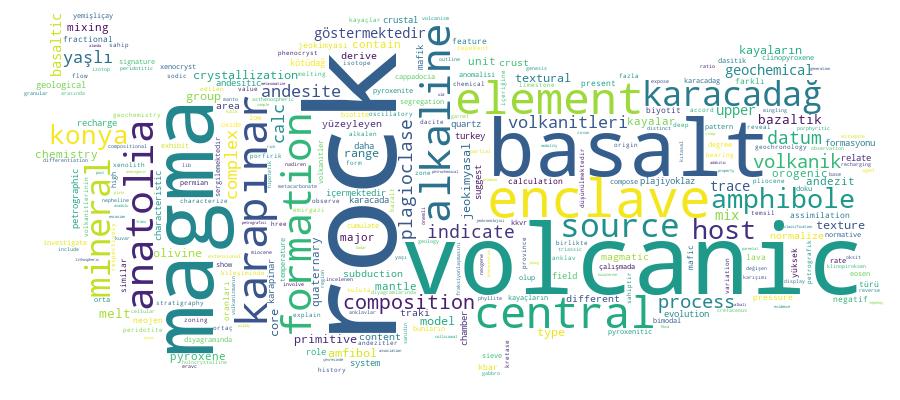
Competency Cloud